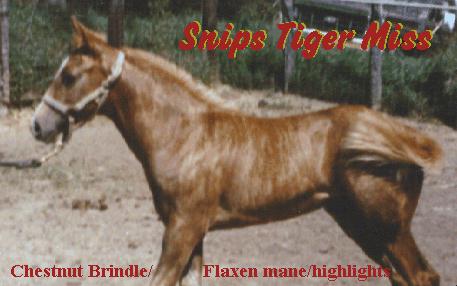
Snips Tiger Miss was one of 4 foals out of the mare Codys Lady Lad. Her sire was Queens Snipper. He has had a total of 43 registered offspring. There are no common ancestors (even remote ones) with any of the other Quarter Horse brindles we have pedigree information on. It is unlikely that either parent was a brindle carrier themselves. Since both parents were registered as sorrels, then any brindle pattern wouldn't have been disguised by a dilution gene, as could have occurred in the case of Dunbars Gold. Thus, Snips Tiger Miss may be an example of brindle occuring as a true "random mutation", rather than as a "crop out" from "brindle carriers", as I feel Dunbars Gold might be. (Dunbars Gold was out a red dun sire and a red dun dam. I have found in my own brindles that dilution genes tend to mask or make the brindle pattern less noticable. Thus I feel one of Dunbars Gold's parents may have been a carrier of brindle, but it wasn't noticed due to their dilution gene. Thus, when he as a non-diluted foal was born showing the brindle pattern, it would seem to have "cropped out").
Unfortunately, Snips Tiger Miss developed a bog spavin and swelling in her her knees and other leg joints, and had to be put down as a yearling in April 1991. Jeanett Hansen wrote that "all her leg joints were in severe arthritic state along with an enlarged heart with floppy valves." Her sire and dam also developed similar symptoms. The sire was put down in August 1991, and the dam died in October 1992. The lab results stated "cause of death unknown". The full sister with the palomino spot survived, and Jeanett said she would keep me informed if she produced any unusually colored foals. While Snips Tiger Miss was probably only a "random mutation", it would be a good idea to examine any other offspring of either Queens Snipper or Codys Lady Lad for evidence of coat texturing or faint brindling patterns.
Click this type to go to our section of unnamed horses, and click each picture to continue. Please see if you can recognize any of these horses. The first three unnamed photographs were probably taken around 1978 to 1980 by Chuck VanHorn of Cave Creek, Arizona, to make a slideshow presentation demonstrating various colors and markings for the International Buckskin Horse Association. Unfortunately, names of the various horses were not recorded. The next two unnamed photographs were taken of Bavarian Warmbloods in 1989 by Evelyn Simak. If you recognize any of these horses, please contact us.
Brindle has occurred in such diverse breeds as Arabians, Thoroughbreds, Mustangs, Quarter Horses, Bavarian Warmbloods, Russian Horses, Spanish Horses, and supposedly also in the Netherlands. Sometimes the pattern seems to be composed of dark hair (black or brown), sometimes of white hair (roan). Since so little information is available on the Brindle pattern in horses, we are not sure if they are from the same gene or not. There could be several genes involved, producing similar patterns ( much as pinto/paint spotting can result from several different genes). Many people confuse Dun Factor markings (stripe down the back, barring on the legs) with brindle. Indeed, there have been many examples of horses that were probably carrying both genes. However, the Russian cab horse, and Brindle mare in the photo you can click to see below, do not have any Dun Factor markings whatsoever. Brindle horses also have texturing in their coat, similar to that seen in some Appaloosa horses. The pattern seems to be inheritable, especially in terms of coat texturing, but the extent of striping is highly variable. However, before we start drawing too many conclusions about the pattern, we need to locate more examples for a study.
Volume 1, number 7. Written information was last updated August 3, 1997. We will update the written information approximately once a month - however, because Brindle Horses are so rare, we may not be able to update the photos in the slideshow that often.